Why Is PDRN Called Salmon DNA, and Is That Accurate?
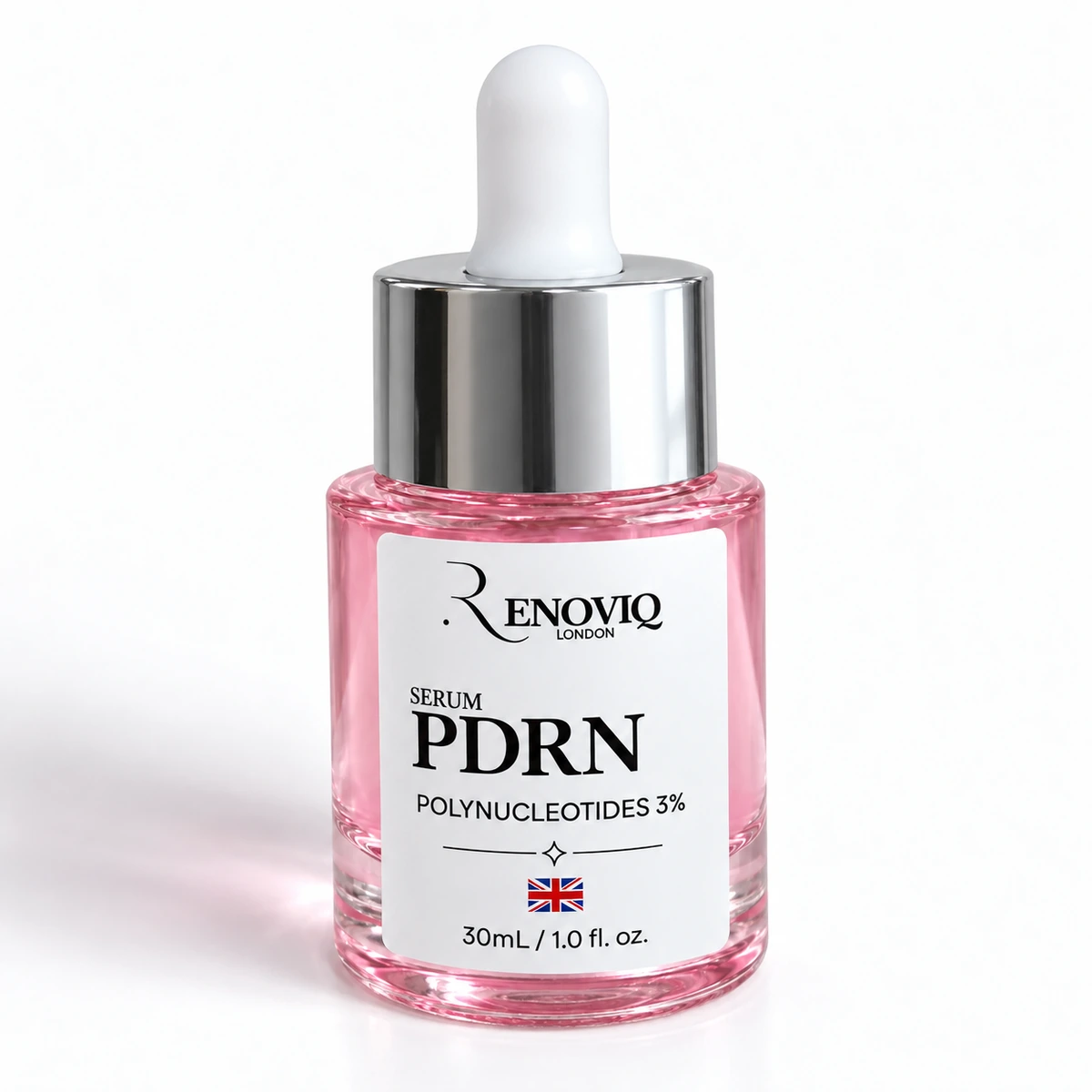
PDRN is often called “salmon DNA” because polynucleotides used in skincare are commonly derived from salmonid DNA. The phrase is a convenient shorthand, but it is not a precise description of the finished cosmetic ingredient. PDRN refers to purified DNA fragments, not raw salmon DNA. For a specific serum, the accurate wording depends on its ingredient and sourcing information. Renoviq London identifies its PDRN — Polynucleotide Repair Serum by its 3% polynucleotides (PDRN) active, without stating a salmon source in the available product facts.
What PDRN actually means
PDRN stands for polydeoxyribonucleotide, a term used for DNA-derived polynucleotide fragments. In beauty conversations, PDRN is frequently grouped under the broader phrase “salmon DNA”, which has become an easy way to signal its common source material. Yet the two terms do not mean exactly the same thing. “Salmon DNA” describes origin at a broad level, while PDRN describes the form of the ingredient after processing and purification. This distinction matters when reading skincare copy. A consumer should not picture fish tissue or untreated DNA in a serum. PDRN is an ingredient category used in formulated skincare, and source, processing and concentration should be identified by the brand where those details are relevant. Clear language makes it easier to compare labels without turning a shorthand phrase into a claim the product information does not support.
Why the phrase “salmon DNA” became popular
The phrase is widely used because salmonid-derived DNA has a long association with PDRN discussions. It is memorable, specific-sounding and simpler to say than polydeoxyribonucleotide. That simplicity also creates confusion. People can assume that every polynucleotide product has the same origin, composition or cosmetic role simply because it is described as salmon DNA. That is not an accurate approach to product comparison. “Salmon DNA” is best understood as informal source-based terminology, not as a complete ingredient specification. A responsible product description should distinguish between the marketing shorthand, the INCI or active description, and any confirmed source details. If a brand does not state the biological source, it is not appropriate to fill in that detail from a wider trend. The label and the brand’s published information remain the most reliable starting point for a particular formula.
Is it accurate to call every PDRN serum salmon DNA?
No. It is accurate only when the product’s documented sourcing supports that description. PDRN can be discussed as DNA-derived polynucleotides, but “salmon DNA” adds a source claim. Source claims require source information. This is especially important in skincare, where ingredient names can be simplified for headlines and social media captions. A precise description does not need to be complicated: PDRN, polynucleotides, DNA-derived polynucleotides, or salmonid-derived PDRN where the brand confirms that origin. Each phrase carries a different level of detail. Consumers who avoid animal-derived ingredients should also look for direct confirmation rather than relying on a nickname. The same principle applies to questions about traceability, processing and suitability. Ask the brand, review the full ingredient information and avoid treating a category term as proof of the exact source used in one particular serum.
How to read Renoviq London’s PDRN description
Renoviq London describes PDRN — Polynucleotide Repair Serum as containing 3% polynucleotides (PDRN). It is a 30 ml serum designed for AM/PM use and sits within the brand’s Repair axis. The available product facts do not identify salmon, salmonid DNA or another biological source for its PDRN. For that reason, calling this particular serum “salmon DNA” would go beyond the stated information. The accurate wording is the wording supplied: a 3% polynucleotide (PDRN) serum. This is not a lesser description; it is simply the specific description that can be supported. When choosing a routine, focus first on the active named on the product, its stated strength and when it is intended to be used. If source is important to your purchasing decision, request confirmation directly before assuming that an industry nickname applies.
FAQ
Does salmon DNA mean there is raw fish DNA in skincare?
No. “Salmon DNA” is commonly used as shorthand for DNA-derived polynucleotide ingredients associated with salmonid sources. It does not mean a skincare serum contains raw fish tissue or untreated salmon DNA. The useful question is what active the product actually identifies and whether it confirms its source. Look for precise ingredient language rather than relying on a headline-friendly nickname.
Is PDRN the same as polynucleotides?
PDRN is a type of polynucleotide ingredient, so the terms are closely related but not always interchangeable in every technical context. In skincare communication, brands often use PDRN and polynucleotides to describe DNA-derived active categories. The most accurate wording for a product is the wording on its own label and published product information, including any stated concentration or source.
Is Renoviq London PDRN made from salmon DNA?
The available Renoviq London facts state that PDRN — Polynucleotide Repair Serum contains 3% polynucleotides (PDRN). They do not state that the active is sourced from salmon or any other biological source. Therefore, it is not accurate to describe this specific serum as salmon DNA based on the information provided. Use the stated product description or ask the brand directly for sourcing confirmation.