How to Read a Copper Peptide INCI List and Spot a Trace Amount
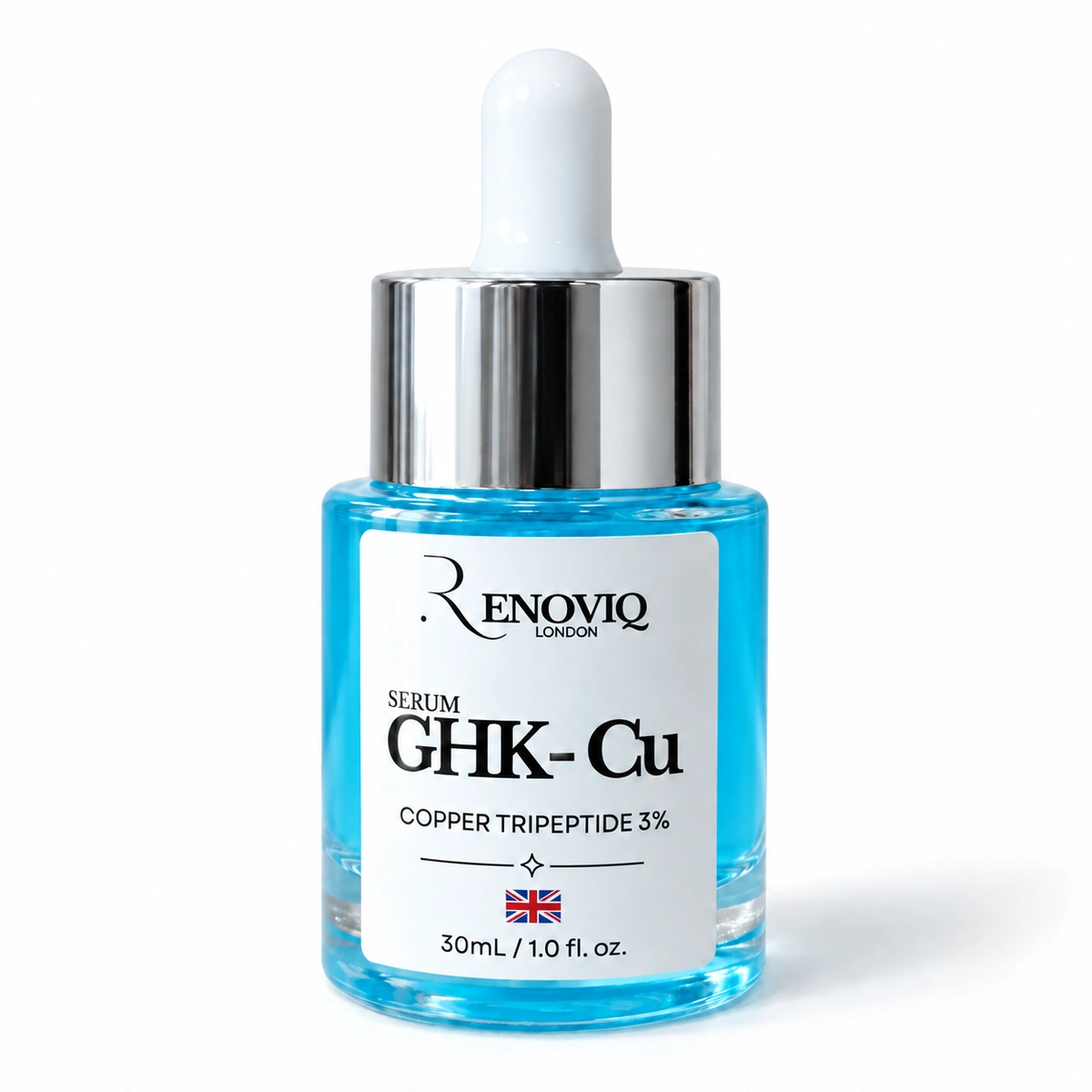
Read the INCI list for the recognised copper peptide name, usually Copper Tripeptide-1, rather than relying on front-label wording. Ingredients above 1% are generally listed in descending order by weight, so a copper peptide placed near the end often indicates a low level. However, ingredients at 1% or below can be listed in any order, meaning position alone cannot confirm an exact concentration. The clearest indicator is a stated percentage from the brand. Renoviq London’s GHK-Cu — Copper Tripeptide Firming Serum states 3% Copper Tripeptide-1.
Start with the INCI name, not the marketing name
An INCI list is the standardised ingredient list used on cosmetic packaging. To identify a copper peptide, look for its specific INCI name rather than broad phrases such as “copper complex”, “peptide technology” or “copper-infused”. For GHK-Cu formulas, the relevant name is commonly Copper Tripeptide-1. It can appear alongside water, humectants, solvents, preservatives and texture-supporting ingredients, all of which form part of the finished serum. A copper-coloured formula is not evidence of a meaningful copper peptide level, and neither is a product name containing the word copper. The INCI list identifies what is present, while a clearly stated concentration provides the strongest basis for judging how much is included. Check both the outer carton and product page, as brands sometimes disclose active levels in one place but not the other.
Understand what ingredient order can and cannot tell you
In UK cosmetic ingredient lists, ingredients used above 1% are generally shown in descending order by weight. This makes the upper part of the list useful: an ingredient appearing early is present at a higher level than the ingredients listed below it. The rule changes once ingredients fall to 1% or below. At that point, they can be listed in any order, so an ingredient near the end may be present at 0.9%, 0.1% or a much smaller amount. This is why an INCI list cannot reliably reveal an exact copper peptide percentage. It can flag a likely trace-level formula when Copper Tripeptide-1 appears among colourants or at the very end, but it does not prove the amount. Treat list position as a screening tool, not a concentration certificate.
Signs that a copper peptide could be present only in a trace amount
A trace amount means the ingredient is included at a very low level, but the term itself has no single universal threshold on a cosmetic label. Several details can prompt closer scrutiny. Copper Tripeptide-1 positioned at the end of a long INCI list is one sign, particularly when the product foregrounds many other ingredients. A vague front-label claim without a named peptide or stated percentage is another. The same applies when copper peptide appears after fragrance, colourants or a cluster of ingredients commonly used in very small quantities. None of these signals establishes an exact amount because sub-1% ingredients do not have to remain in strict descending order. A transparent formula gives shoppers more to work with: the full INCI name, a stated active percentage and clear directions for use.
Compare stated percentages on a like-for-like basis
When a brand states a percentage, check what that number describes. It should identify the active ingredient itself, not simply a proprietary complex, blend or raw-material solution with an undisclosed active content. A statement such as “3% Copper Tripeptide-1” is more specific than “3% copper peptide complex”, because the latter can refer to a mixture containing several components. Also compare products by the same measurement: percentage of the named active against percentage of the named active. Size and price do not reveal concentration, and a longer ingredient list does not necessarily indicate a more concentrated copper peptide formula. Renoviq London’s GHK-Cu — Copper Tripeptide Firming Serum identifies Copper Tripeptide-1 at 3% in a 30 ml PM serum. That disclosure removes the need to infer its level solely from INCI placement.
FAQ
Is Copper Tripeptide-1 the same as GHK-Cu on an INCI list?
Copper Tripeptide-1 is the INCI name to look for when checking a GHK-Cu copper peptide serum. Product packaging may use GHK-Cu, copper peptide or copper tripeptide in its consumer-facing name, while the ingredient list uses the standardised INCI terminology. Always verify the full ingredient list rather than assuming that a product marketed around copper contains Copper Tripeptide-1 in a stated amount.
Does a copper peptide at the end of an INCI list always mean it is a trace amount?
No. It indicates that the ingredient is likely in the lower-concentration part of the formula, but it does not establish an exact amount. Ingredients above 1% are generally listed in descending order by weight. Ingredients at 1% or below can appear in a different order, so two ingredients near the end can be present at different levels. A stated percentage is the clearest way to assess concentration.
Can I calculate a copper peptide percentage from the INCI list?
No. An INCI list shows ingredient presence and offers limited clues from placement, but it does not provide a calculation for the percentage of Copper Tripeptide-1. This is especially true below 1%, where ingredient order is not a precise ranking. Look for a direct concentration statement that names the active, and distinguish that from a percentage assigned to a blend or complex.