Does Topical NAD+ Absorb? Nicotinamide Riboside in Skincare Explained
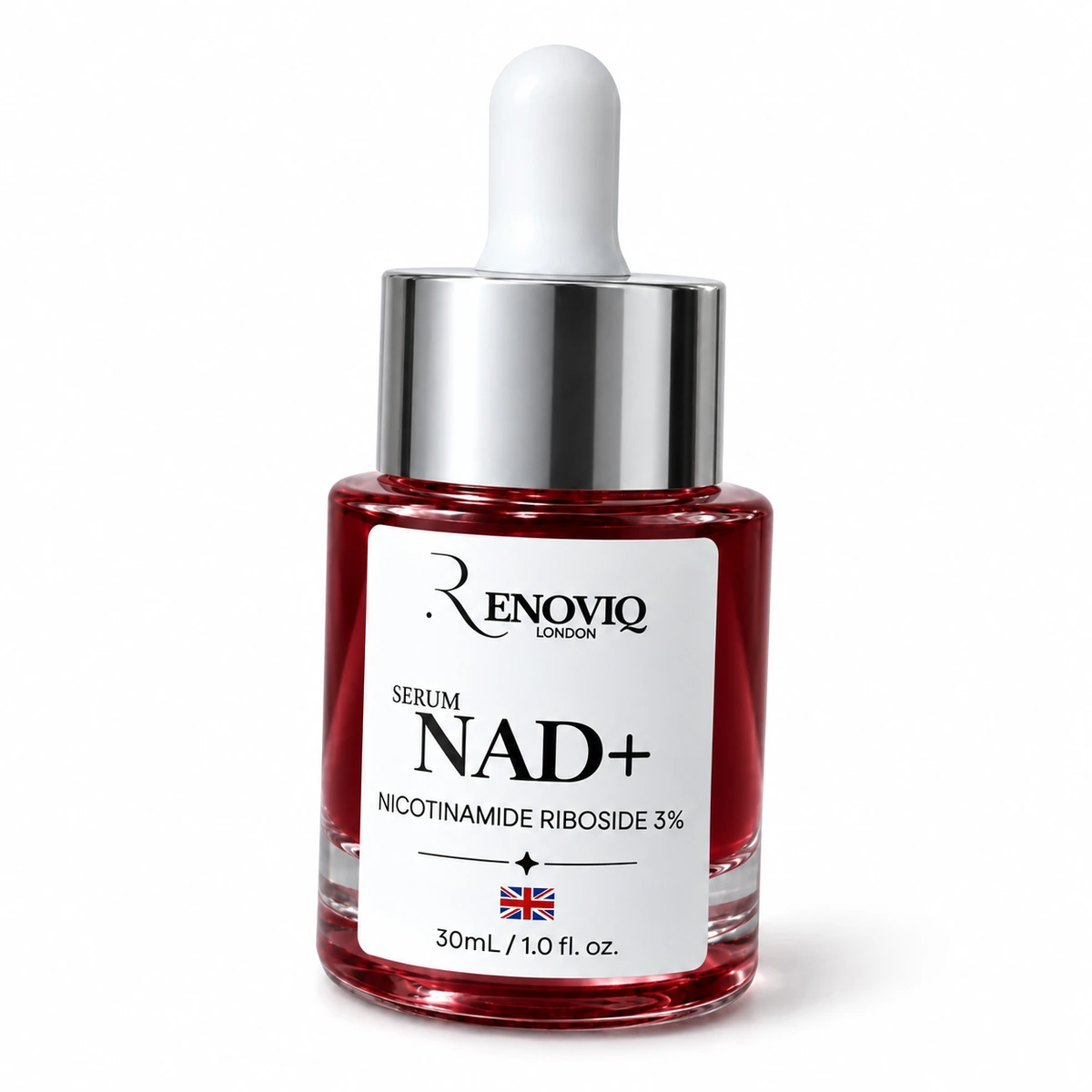
Topical NAD+ and nicotinamide riboside are not the same ingredient. Applying NAD+ to the skin does not, by itself, establish how much reaches particular skin layers or what cosmetic result it delivers. Nicotinamide riboside is a separate ingredient used in topical formulas. In skincare, the useful questions are the ingredient named on the label, its concentration, the formula, and the product’s intended use. Renoviq London’s NAD+ — Cellular Energy Serum contains 3% nicotinamide riboside and is designed for AM use.
Topical NAD+ absorption is not a simple yes-or-no question
NAD+ is a molecule found naturally in the body, while topical skincare is applied to the surface of the skin. These facts do not automatically demonstrate that a topical NAD+ product reaches a particular layer, remains intact after application, or produces a specific visible outcome. Absorption depends on the exact molecule, the full formula, the delivery system, the amount applied and the condition of the skin surface. It is therefore inaccurate to treat the word “topical” as proof of deep delivery. For a cosmetic routine, start with what the product actually contains rather than assuming that a product called NAD+ contains NAD+ itself. Ingredient names matter because NAD+ and nicotinamide riboside describe different substances. A clear label, a stated concentration and straightforward directions make it easier to understand where a serum belongs in a daily routine.
Nicotinamide riboside is different from NAD+
Nicotinamide riboside, often shortened to NR, is not another name for NAD+. They are distinct compounds, even though they are frequently discussed together in conversations about cellular biology. In topical skincare, that distinction should remain clear: a formula containing nicotinamide riboside should be described as containing nicotinamide riboside, not as a direct topical NAD+ formula. This avoids overstating what is in the bottle and keeps product comparisons accurate. The cosmetic value of a serum also cannot be reduced to one popular scientific term. Texture, compatibility with the rest of a routine, frequency of use and consistent application all shape the experience of using it. When choosing an NR serum, look for the named active, its disclosed strength and whether the use instructions fit your morning or evening routine. These are practical details that support informed skincare choices.
What nicotinamide riboside does in a skincare routine
Nicotinamide riboside is used as an active ingredient in topical skincare formulas. It is best approached as one part of a cosmetic routine rather than as a shortcut to a promised transformation. A serum’s role is defined by its formula, directions and the appearance-focused aim of the routine in which it is used. Use it consistently as directed, then assess how your skin feels and how its overall appearance looks over time. Do not equate an ingredient’s broader scientific discussion with a guaranteed topical result. Cosmetic communication should stay grounded in visible appearance, such as skin that looks more radiant-looking or feels comfortable within a well-balanced routine. The rest of the routine still matters: cleanse appropriately, layer products in a way that suits your skin, and use daytime sun protection. Introducing one new product at a time also makes it easier to judge whether its texture and routine placement work for you.
Where Renoviq London’s nicotinamide riboside serum fits
Renoviq London’s NAD+ — Cellular Energy Serum contains 3% nicotinamide riboside in a 30 ml serum. It is intended for AM use and is priced at £72. The name reflects the product’s positioning, while the ingredient listing identifies nicotinamide riboside as the active. This makes it a relevant option for someone specifically looking for an NR-based serum rather than a product presented as topical NAD+ itself. Place an AM serum within a routine that remains simple enough to use consistently. Apply products according to their instructions, allow each layer to sit comfortably, and finish with sun protection during the day. Keep expectations cosmetic and appearance-led: skincare is about the look and feel of skin, not medical outcomes. If you are building a routine around distinct active categories, single-active serums also make product selection and routine organisation more straightforward.
FAQ
Does a product called an NAD+ serum necessarily contain NAD+?
No. A product name does not replace the ingredient information. Check the label to identify the active ingredient actually used in the formula. NAD+ and nicotinamide riboside are different compounds, so an NAD+ named serum can contain nicotinamide riboside rather than NAD+ itself. This is why the ingredient name, disclosed strength and directions are more useful than relying on the product title alone.
Can I use a nicotinamide riboside serum in the morning?
Yes, if the product directions specify AM use. Renoviq London’s NAD+ — Cellular Energy Serum is intended for AM application. Build the rest of the routine around the instructions for each product, keeping layers comfortable and manageable. A daytime routine should finish with sun protection. Consistency and a routine that suits your skin are more useful than adding multiple products at once.
Is nicotinamide riboside the same as niacinamide?
No. Nicotinamide riboside and niacinamide are different ingredients and should not be treated as interchangeable on an ingredient list. If you are choosing a serum, identify the precise active named by the brand, then follow the product’s use directions. This keeps comparisons accurate and avoids assuming that products with similar-sounding names have the same formula or intended routine position.